
Plan Team-Building Camp Activities for Next Summer
Between weather, staff changes, and new campers each week, the best activities are the ones you can count on. Now is a good time to plan for games that are fun, repeatable, and built for group connection.
As you’re gearing up for the next season of camp, take a moment and think over past years. When you consider your camp activities, are they accomplishing the goals you’ve established? Teamwork rarely happens by accident. When you build it into the schedule on purpose, you get more cooperation at meals, smoother cabin time, and campers who start rooting for each other
Benefits of Team-Building Activities
If you haven’t had a specific focus on teamwork and team-based games and activities, it may be time to increase this aspect of your camp. Team-building activities do more than fill a time slot between swim and lunch. They shape how campers communicate, solve problems, and bounce back after mistakes. The best ones feel like play, but they’re doing real work underneath.
Not sure it’s that big of a deal? Here are four key areas of character development you’ll support with a team-focused game like 9 Square in the Air:
Social Skills:
When playing a team game like 9 Square in the Air, campers get a keen sense of their role in the game. If they are in the center, they know they will have to serve, but every square has its area of responsibility. As they wait their turn to get into the rotation, they’ll have the opportunity to encourage other players and talk with those in line.
These skills are crucial for growth, giving each child an understanding of sharing responsibility with their team and the important role they play either in the game or in supporting those in active play.
Self-Confidence:
As kids join in a team-building game like 9 Square in the Air, they develop a feeling of belonging. Teammates may cheer when they succeed in a difficult play, or they may gain perspective when they see that a miss is quickly forgotten. Participating in team-building games helps campers gain confidence in their contribution to the overall outcome.
Decision-Making:
A quick-moving game like 9 Square in the Air may obscure the critical decision-making skills that are developing during play. The low-pressure setting gives campers a chance to see how their decisions play out and helps them gain comfort so that decision-making becomes more natural to them.
Empathy:
Everyone misses now and then. 9 Square in the Air is ideal for building empathy in kids because there are so many opportunities to miss, recover and get back in the game. They get a chance to see how it feels to miss, how their fellow campers bounce back from a miss and how to effectively encourage one another to get back in the game.
The beauty of these benefits is that they extend far beyond the game. As your campers are in your care, it’s so rewarding to see them growing through team-building camp activities.
And it doesn’t hurt if you can have fun while you’re at it. Contact us at 9 Square in the Air to learn how you can include the ideal team-building game in your camp activities this season.
11 Team Building Activities For Every Setting
Whether you’re planning for camp free time, cabin competitions, or rainy-day backups, these team-building activities work in a gym, on a field, or in a rec room. They’re easy to run and great for mixed ages.
1. 9 Square in the Air:
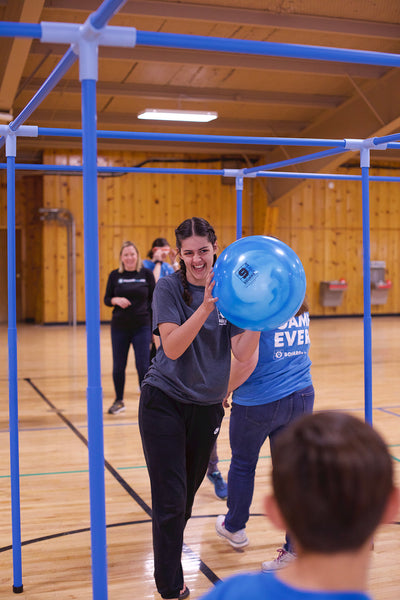
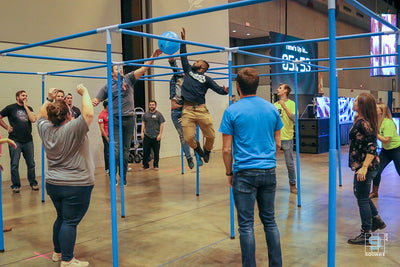
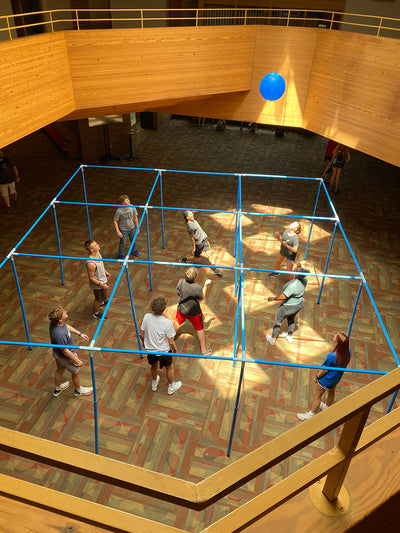
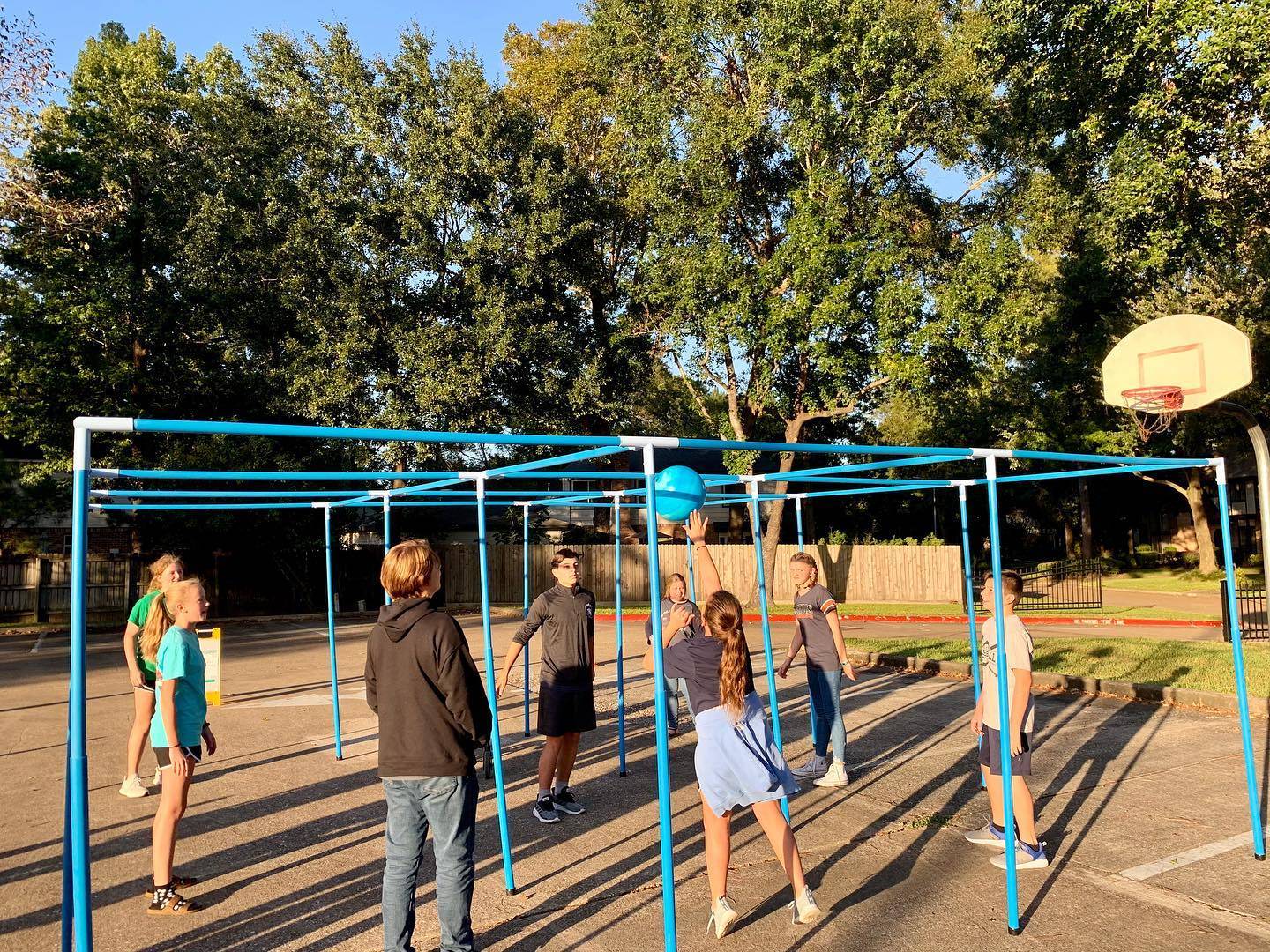
9 Square in the Air is a group game played with a ball inside a nine-square structure. The goal is to advance through the squares to the center and stay there as long as you can.
The player in the center square serves the ball to any other square. The receiving player must hit the ball out of the top of their square and into another player’s square, and each player gets one hit per turn. Play keeps moving until someone is eliminated, then players rotate clockwise to fill the open square, and a new player enters square one.
For team building, it works because campers naturally encourage each other while waiting in line, communicate during fast plays, and learn to bounce back quickly after a miss.
2. Gaga Ball:
Gaga Ball is a dodgeball-style game played inside a “pit” with walls that keep the ball contained. Players hit the ball with their hands and aim below the knee, and the goal is to be the last player standing.
It’s great for team building because it teaches awareness, fast communication, and sportsmanship in a short time window. Campers learn to respect boundaries, follow simple rules, and read the group’s energy. It’s also a strong option for mixed ages, since counselors can adjust the pace with the type of ball and the number of players in a round. When you run Gaga Ball as cabin versus cabin, it becomes an instant bonding moment.
3. 4 Square in the Air:
4 Square in the Air is a smaller “in the air” version of the square-based play style, built for groups that want a similar experience in a more compact setup. Like 9 Square in the Air, play centers on hitting a ball from square to square inside the frame, keeping the action moving and bringing new players in through rotation.
It’s a strong team-building option for camps because campers learn quick communication, take turns, and encourage each other after mistakes. It also works well as a station activity when you have multiple games running at once, since groups can rotate through without long downtime.
4. Bucket Golf:
BucketGolf is a portable golf-style game where players hit balls into pop-up buckets that act as the holes. The 6-hole set includes six buckets, flagsticks, balls, tee boxes, scorecards, and a carry bag, making it easy to set up anywhere around camp. Teams can lay out their own course across open fields, grass areas, or large indoor spaces, then take turns playing each hole.
For team building, BucketGolf works because it encourages patience, turn-taking, and positive encouragement between shots. Campers naturally cheer each other on, help track scores, and celebrate small wins together. It also allows mixed skill levels to play side by side without pressure, since accuracy matters more than strength. Running BucketGolf as cabin teams or rotating groups keeps everyone involved and gives campers a shared goal to work toward.
5. Disc It:
Disc It is a team disc game where players pass a sport disc and shoot at a scoring pole. Points are earned by hitting the pole, with the black and yellow sections worth different scores. Teams play to 11 points and must win by two.
The game includes a Penalty Zone, and stepping into it triggers penalties, so teams have to balance smart positioning with aggressive plays. Turnovers, interceptions, and rebounds keep the pace quick and give every camper a chance to make an impact, even if they aren’t the strongest thrower.
For team building, Disc It pushes communication, quick decision-making, and trust, since clean passes set up the best shots. The set includes a collapsible pole, an easy-folding Penalty Zone, a starting marker, a sport disc, a storage bag, and a rule card for easy setup.
6. PowerPoint Karaoke:
PowerPoint Karaoke is simple: campers present a slide deck they’ve never seen before. The slides can be funny, random, or themed around camp life. It’s surprisingly powerful for team building because it builds trust and comfort with being imperfect in front of others.
Pair campers up so one presents and one “translates” what the slide means, then switch. Keep it short, like 60 to 90 seconds each, so it stays light and nobody spirals. The group practice is cheering, listening, and building each other up, which carries over into more serious team moments later in the week. It also helps counselors spot campers who need a confidence boost and give them an easy win.
7. Tug-of-War:
Tug-of-War is classic for a reason. It’s physical, loud, and instantly team-focused. The key is running it in a way that teaches teamwork, not just strength. Set clear rules, use even teams, and focus on coordination: timing the pulls, calling a rhythm, and responding together. You can run best-of-three rounds, then mix the teams so campers learn to work with different people.
Add a “strategy huddle” before each round where campers decide how they’ll communicate during the pull. Afterward, do a quick reset where each team says one thing they did well together. That reflection turns a simple game into a real team-building moment.
8. Scavenger Hunt:
A scavenger hunt is one of the easiest, most fun ways to build cooperation fast, especially early in the week. Give teams a list of items, locations, or challenges that require different strengths.
One camper might be the map reader, another the photographer, another the runner, another the clue solver. Include a few tasks that can’t be completed alone, like “get a group photo with your whole team doing the same pose” or “find a counselor and ask a question about camp rules.” Team building happens because campers have to plan, divide roles, and manage time. End with a share-out where teams explain their funniest moment or hardest clue, so everyone feels included.
9. Group Jump Rope:
Group jump rope is sneaky-good for teamwork because success depends on timing and communication, not athletic talent. Start with two rope turners and one jumper, then build toward two or three jumpers at once. The group has to talk through cues like “ready,” “go,” and “switch.” If someone trips, the best teams reset quickly without teasing, so it’s a nice way to coach positive culture.
For a cabin challenge, set a goal like “20 total jumps as a group,” then let campers choose how they want to rotate jumpers. You can also add fun variations like jumping while saying cabin chants. It’s simple, portable, and perfect for short time blocks.
10. Human Knot:
Human Knot is a low-equipment team-builder that forces campers to slow down and problem-solve together. Put a group in a circle, have everyone reach in and grab two different hands, then challenge them to untangle into a circle without letting go.
The benefits are immediate: communication, patience, and leadership without taking over. The best part is how it reveals team habits. Some groups rush and get stuck. Others pause, listen, and solve it step by step. You can reinforce healthy teamwork by assigning roles like “communicator” (talks through next steps) and “spotter” (watches for twisted arms). Keep group size reasonable so it stays fun, not frustrating.
11. Common Denominator:
Common Denominator is a fast connection game that works anywhere, even in a cabin or dining hall. Split campers into small groups and give them a short time limit, like two minutes, to find what they all have in common. Then they share their list with the larger group. It’s team building because it helps campers see each other as more than “the loud kid” or “the shy one.” They start noticing shared experiences, interests, or funny habits, and that lowers the social pressure fast. You can level it up by adding a second round where groups must find common ground with a new set of people, so cliques don’t lock in early.
Conclusion
Team-building gets easier when you have games campers actually want to play, and counselors can set up fast. If you’re planning next summer now, stock your activity lineup early. Shop 9 Square in the Air and bring proven group games to your camp.